The RB26dett uses top feed, low impedance fuel injectors that are rated at 444cc. They are silver/black body with a yellow square EV1 electrical connector. The top feed size is 10.5 mm.
If you have ever dropped one down in the black hole of the engine compartment, you know what we are talking about. The design of these things is pretty awful. These are EV1 connectors, so there are some better replacements out there, but depends on how far you want to go into new wiring.
Cleaning Fuel Injectors
You can see from the picture below, just one example of fuel injector cleaning and balancing. We normally take injectors to RC Engineering in Torrance, California. They have been working on injectors for us for over 20 years. We nearly always notice a much smoother idle and less small pops and stumbles with a cleaned set of injectors. Not sure about how often to clean injectors, but 25 years seems to be well within reason. This helps a lot with emissions.
You can see that with cleaning, the fuel injectors can safely supply from 316 hp to 411 hp of fuel, vs 249 hp to 324 hp prior to cleaning. If you let fuel injectors sit for too long, they can lock up, so we do recommend hitting them with 12 volts prior to installation. Or if you install them, and have a hard misfire, check each injector that it isn’t stuck. An injector is just a solenoid. So it needs a power and ground, hooked up either way to energize and move. You can hear and feel the solenoids in the injectors move when you energize them. We also recommend OEM fuel injector o-rings over the o-rings that RC supplies. Their top o-ring(green) is designed for an 11mm rail, and does not like fitting in a stock 10.5 mm rail.
Drop in 1000cc injectors, does not mean that you don’t have to tune them. It just means that you don’t have to get all crazy with the fuel rail or other parts to make the fuel injectors fit. These will supply enough fuel for about 900 hp at the engine on gasoline. More information on E85 requirements and injectors can be found in the Fuel System post below.
Often specified as original equipment, NGK spark plugs are the best combination of performance and longevity. Offering the Quality, Reliability and Durability You'd Expect from an OEM Manufacturer NGK is the world's largest supplier of OEM spark plug… read more
The details interface only displays some car models. To view all car models, please click on the top of the interface"make sure this fits" Fitment1: Nissan 370Z Maxima Murano Pathfinder Quest GT-R Altima 350Z Frontier|SL 2003-2024|SV 2009-2024|S 2004… read more
【OE Standard】Our spark plugs meet or exceed OE specifications for form, fit and function and are perfect for automotive replacement spark plugs.Quick and easy installation, excellent and reliable performance. Premium spark plug kits are a quick and e… read more
The RB26dett uses top feed, low impedance fuel injectors that are rated at 444cc. They are silver/black body with a yellow square EV1 electrical connector. The top feed size is 10.5 mm.
If you have ever dropped one down in the black hole of the engine compartment, you know what we are talking about. The design of these things is pretty awful. These are EV1 connectors, so there are some better replacements out there, but depends on how far you want to go into new wiring.
Cleaning Fuel Injectors
You can see from the picture below, just one example of fuel injector cleaning and balancing. We normally take injectors to RC Engineering in Torrance, California. They have been working on injectors for us for over 20 years. We nearly always notice a much smoother idle and less small pops and stumbles with a cleaned set of injectors. Not sure about how often to clean injectors, but 25 years seems to be well within reason. This helps a lot with emissions.
You can see that with cleaning, the fuel injectors can safely supply from 316 hp to 411 hp of fuel, vs 249 hp to 324 hp prior to cleaning. If you let fuel injectors sit for too long, they can lock up, so we do recommend hitting them with 12 volts prior to installation. Or if you install them, and have a hard misfire, check each injector that it isn’t stuck. An injector is just a solenoid. So it needs a power and ground, hooked up either way to energize and move. You can hear and feel the solenoids in the injectors move when you energize them. We also recommend OEM fuel injector o-rings over the o-rings that RC supplies. Their top o-ring(green) is designed for an 11mm rail, and does not like fitting in a stock 10.5 mm rail.
Drop in 1000cc injectors, does not mean that you don’t have to tune them. It just means that you don’t have to get all crazy with the fuel rail or other parts to make the fuel injectors fit. These will supply enough fuel for about 900 hp at the engine on gasoline. More information on E85 requirements and injectors can be found in the Fuel System post below.
Often specified as original equipment, NGK spark plugs are the best combination of performance and longevity. Offering the Quality, Reliability and Durability You'd Expect from an OEM Manufacturer NGK is the world's largest supplier of OEM spark plug… read more
The details interface only displays some car models. To view all car models, please click on the top of the interface"make sure this fits" Fitment1: Nissan 370Z Maxima Murano Pathfinder Quest GT-R Altima 350Z Frontier|SL 2003-2024|SV 2009-2024|S 2004… read more
【OE Standard】Our spark plugs meet or exceed OE specifications for form, fit and function and are perfect for automotive replacement spark plugs.Quick and easy installation, excellent and reliable performance. Premium spark plug kits are a quick and e… read more
Fuel. In order to make horsepower in a Nissan Skyline GT-R, you need fuel and air. The air and fuel mixture are forced into the combustion chamber by our friend, the twin turbochargers(why have one, when you can have two?), which then produces the horsepower/torque we demand with our right foot.
Stock fuel rail modified by Alex Rodriguez Motorsports. -8 AN fitting
As the horsepower requirements increase, the fuel requirements increase. The fuel system, and that is an important set of words, needs to be adequate enough to supply enough fuel. If you don’t supply enough fuel, you will inevitably end up with a dead engine. Another very important thing to note is fuel flow vs fuel pressure vs voltage.
Fuel System: Fuel Tank
Fuel Pump
Fuel Pulsator
Fuel Pump Control Module (FPCM)
If any part of the fuel system is not adequate, you are just asking for problems. So pay careful attention to it. About 90% of the time we are on a dyno with a car, the fuel system is the limiting factor. Build the fuel system with enough capacity for your horsepower goals.
The questions to ask
How much horsepower are you looking to make?
What kind of fuel do you use?
How much money are you willing to spend?
How is the car used?
How much horsepower are you looking to make?
Horsepower. Just about everyone wants a 500, or 600, or 1000 hp car. Assuming everything else with handle it, lets just focus on the fueling requirements of the engine.
RB26, we have 6 injectors. The factory injectors are low impedance, and they have a resistor box in the circuit. This is important, as most modern injectors are high impedance, and can eliminate the resistor box. HOWEVER, if you eliminate the resistor box, with a normal ECU, and low impedence injectors, you will probably burn out the injector drivers. So make sure what you have, before you go eliminating parts.
A fairly safe rule of thumb on a 6 cylinder engine on gasoline is about 1 hp per cc at the engine. So a stock 440 cc(485 cc at 43 psi) injector is enough for about 440 hp (485 hp) at the engine on an RB26. In real life you can push it harder, or see less depending on the condition of the entire fuel system.
Here is an example to figure out what fuel requirements an RB26 would want at a 0.60 BSFC, 280 horsepower, 6 injectors, and 80% duty cycle. An injector is a solenoid, and it needs off time to work correctly. We can not realistically ask it to be 100% open all the time, so we normally use 80% in a fuel injector calculator, to give the injector 20% off time.
BSFC x HP/6 injectors x .80 duty cycle (%)
0.60 BSFC (Gasoline) x 280 hp /6 x .80 = 35.2 lbs/hr or 370cc
0.84 BSFC (E85) x 280 hp/6 x .80 = 49.2 lbs/hr or 518cc
You can see that even at stock horsepower on E85, our factory 440 cc(485 cc) injectors would be too small to provide the fuel required by the engine safely. If you push fuel pressure, or duty cycle, you could get them to work at “stock” horsepower but don’t do that please.
The Injector Dynamics fuel flow calculator is a departure from traditional online calculators which rely on Brake Specific Fuel Consumption (BSFC). There are two sources of error inherent in BSFC based fuel flow calculations. First, BSFC is a rarely measured parameter which few will have access to, and second, being a measure of efficiency, it is dependent on any factor that would affect the overall efficiency of the engine. For instance, a high boost engine running pump gas may require 10-15 degrees less ignition advance than the same engine running race gas. This reduction in timing, and the corresponding reduction in power will have a direct and proportional effect on fuel efficiency, or BSFC. For the reasons stated above, fuel flow calculations based on an estimated BSFC value are so error prone, that the are often meaningless. The Injector Dynamics fuel flow calculator is not based on efficiency. It works by estimating airflow based on a few known parameters, and then calculating fuel flow directly from exhaust lambda. The result is a far more accurate estimation, which allows you to pick the right injector the first time. To choose the best fuel injector for your application, enter the required parameters, click the submit button, and note the injector duty cycle required for the conditions you have specified.
To convert cc / min to lbs. / hr. – Divide by 10.5
To convert lbs. / hr to gal. / hr. – Divide by 6
To convert cc / min to gal. / hr. – Multiply by .015873
Lambda and AFR for Gasoline, E10, E85, and Ethanol
How much money are you willing to spend?
This is obviously all up to you, however if there is anywhere not to skimp out, it would be your fuel system.
Fuelab Prodigy 1300hp pump 550.00
Fuelab electronic regulator 400.00
Tomei rail 370
Id1700cc injectors 1500.00
Flex sensor 180
Pre pump fuelab 75 mic filter 155
Post pump fuelab 6 mic filter with check valve 210
Fuel cell 220
How is the car used?
Factory fuel pump in its small sump. The return line puts fuel back to the inlet of the pump . Fuel Pulsator is also visible
You can get away with some things on a car that is only street driven, or only driven at a drag strip. There are some fuel slosh issues with an R32 GT-R fuel tank, as it is wide and flat. If you run it too low, then you can lean out the engine and blow it up. The factory pump is in a small sump, and we highly recommend keeping that sump or using something bigger/better.
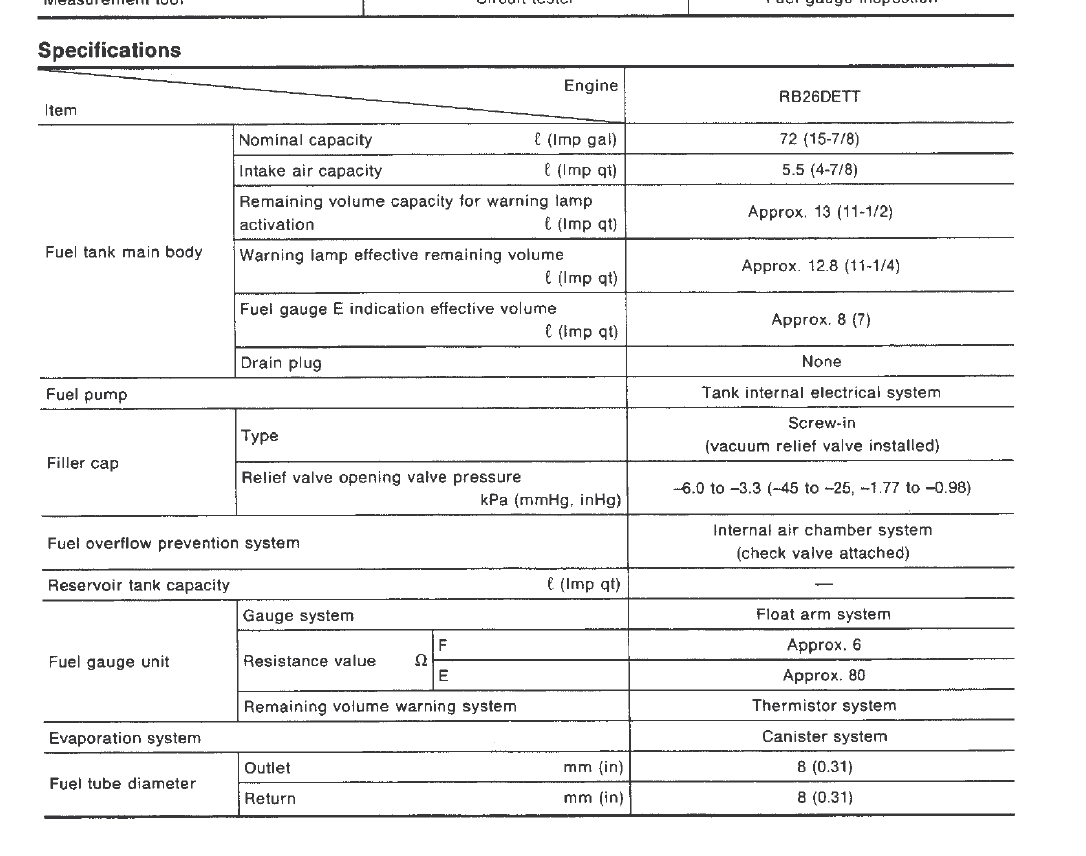
R32 GT-R Fuel tank capacity and fuel tank specifications
R32 GT-R fuel tank capacity is listed as
72 liters
19 gallons.
Most of the time E to full is about 17 gallons.
I never like running cars too low on fuel, as you suck up any trash in the bottom of the tank, and fuel is used to cool and lubricate the fuel pump.
R33 GT-R fuel tank capacity
65 liters
17 gallons
I don’t think it will take anywhere near 65 liters(17 gallons US), even though that’s what all the books say. I think normally I wouldn’t get much more than about 13-14 gallons US(50 liters) in the tank.
R34 GT-R fuel tank capacity
65 liters
17 gallons
S14 fuel tank capacity
65 liters, anyone see a trend?
Cars have one, it is where it is stock. Not a ton you can do about it without some major rethinking. As you can see the OEM R32 is wide and flat. This means that fuel can slosh away from the fuel pickup fairly easily. Mr. T said to put fuel cell foam in the tank to help prevent slosh, but then it will have a tendency to foul the tank level sensor. The foam also has a finite life, and may not like ethanol much.
Holley has a product called Hydramat. The Hydramat acts as a reservoir, and will help prevent fuel starvation. Here is what they have to say about it.
Fuel reservoir system designed to reduce fuel starvation issues present in hard cornering, acceleration, stopping, inclines, and low fuel conditions
Available in various shapes and sizes for installation in stock fuel tanks and/or racing fuel cells
Patent pending design that solves the problems associated with traditional fuel pick-ups in stock fuel tanks as well as racing fuel cells
Greatly reduces the potential for air to enter into the fuel system which can result in poor engine performance and/or engine stalling
Perfect for vehicles experiencing fuel starvation during hard cornering, acceleration, stopping, inclines, and low fuel conditions
Surface tension and fluid wicking allow the HydraMat™ to continue to draw fuel from the tank or cell even when part of the mat uncovered
As an area of the HydraMat™ is uncovered, tiny pores in the media seal off through surface tension, forcing fuel to be drawn from other areas of the mat where fuel continues to be available
Unique internal reservoir assists in keeping fuel available at the pickup even under extreme fuel slosh conditions
Eliminates the need for specialty reservoirs, sumps and pick up pumps saving cost and greatly reducing complexity
Also acts as a 15 micron pre-filter eliminating the need for a separate filter before the fuel pump
We have run Hydramat on several vehicles now. It will suck the fuel tank very dry. Great addition. There is a cost, but then again, keeping everything in the tank, helps to lessen failure points.
Perished top tank vent. This tank leaked from here when filling.
Some people, when having to change the fuel tank, have installed a S13 240SX fuel tank. It is metal, the filler neck needs to be swapped over. Mostly the non- GT-R R32 have fuel tank rust issues. Some people have said that they split R32 GT-R fuel tanks, but it is mostly the vent lines on the tank that leak.
The stock R32 GT-R fuel pump is/was 190 l/hr or 50 gallons an hour. However that one rating isn’t really enough to tell you everything you need to know about a fuel pump. The problem is that fuel flow decreases with pressure. Normal fuel pressure in most older return type fuel systems is around 3.05 kg/cm or 43 psi at idle.
OEM Fuel Pump Assembly R32 GT-R – 17042-05U00
The Stealth 316 page, is one that I have been referring to for years. Has tons of great information on fuel pumps, and fuel flow.
In the April 2004 issue of Turbo & High-Tech Performance magazine, a stock R33 Skyline GT-R fuel pump was tested to flow 252 lph at 43.5 psi and 13.5 volts. All three of those numbers are important. Flow, at pressure and voltage. Just one number alone may be impressive, but you need to see the whole chart, at pressure and voltage to make good fuel system decisions.
At a point, many fuel pumps have relief valves that open, and you get no more fuel. This is also something very important to know.
Most of our Nissan Skylines are at least 25 years old. At that age, things wear out, or will eventually wear out. On our NISMO #500, we decided to get preemptive and ordered a NISMO fuel pump to replace the OEM fuel pump. We see it as cheap insurance. The NISMO pumps are great pumps, drop in, and have low failure rates. Stock R32 is rated at 195 L/hr . Nismo replacement is rated at 276 l/hr. More fuel pump info – Stealth 316. The single NISMO pump, at OEM voltages is good to about 500 wheel horsepower and 75 psi fuel pressure. Above that you need to start thinking about some complex fuel systems.
You can double up on the stock intank pumps. AKA two stock fuel pumps. Or one stock and one something else. Or two NISMO, or two Walbro, or two Bosch. It always seems that even though on paper two pumps should flow double the amount of fuel, real life we don’t see that. You might only see 1.5-1.75 times as much flow due to limitations elsewhere in the system.
We used to wonder about the fuel systems that Toyota Supra guys ran in their cars, to support the horsepower they were running, and honestly they look just the clusterfuck. They may work, but adding complexity and failure points to a system as critical as the fuel system isn’t really how you should build a car. However, compromises when there are no great single solutions.
The Bosch 044 is still such a buff pump. 300 l/hr at 40 psi. About 270 l/hr at 100 psi. This is why in about every serious race car setup I have ever played with, we use the Bosch 044. The 044 is good for a maximum of 500 hours on E26 to E85 according to Bosch. They are loud, they move some fuel. I have seen them keep right on pumping to 120 psi fuel pressure. Most normal pumps don’t want to suck and push fuel. Most pumps want to not have to do both, but that old 044 will motor on through it. All the old Nissan Skyline GT-R drag cars from Japan would have systems with three or four 044 pumps. Each one enough for about 500 hp.
Bosch 044 as a reserve pump in R34 N1 Super Taikyu car
We still see it on some of the systems for the R35 GT-R. However when you are looking to make several thousand horsepower, compromises are made. We are starting to see brushless pumps, and some other interesting developments, but they aren’t for the faint of wallet.
Frenchy’s Performance Fuel Pump for stock R32 GT-R fuel tank
The Frenchy’s Performance fuel pump setup we decided on for our R32 is a dual pump, dual power -8 supply and feed.
R32 GT-R intank fuel system kits. Unique design, easy installation, plug and play with factory harness. First ever kit to incorporate a baffle inside the tank to prevent surge. All components are E85 safe and many options are available: single pump or twin pump, -6 or -8 fittings, screw on or push on hose fittings, wiring kit. The single pump can support up to 500hp at the wheels and the twin pump up to 1000hp. The kits come with genuine Walbro F90000267 pumps. Comes with a fuel level sender calibrated to work with the factory gauge. All stainless steel hardware, anodised aluminium components, milspec wiring, Siemens sensor.
There is a point, that it seems no amount of electric fuel pump will supply enough fuel. Platnium Racing Products (PRP) in Australia developed a system using proven mechanically driven fuel pumps to supply fuel.
Mechanical Fuel pumps. with great power comes the need for dependable fuel delivery. The modern performance car is using so much more fuel to make the average 1000hp street car these days, there is a much simpler and in some ways primitive fuel system available to you right now being the PRP Cam driven Mechanical fuel pump system. No wiring, no current draw, no need for upgraded alternators required to power up the nostalgic 044 or newer version in-tank pump that draws 18 amps, this system is bulletproof. Its quiet, its lite, it is extremely reliable, and this system has been used for decades in Indy, Nascar, sprint car racing you name it, even light aircraft it works, whether you use it for street or track it’s efficient and the way of the future.
PRP has designed a billet alloy bracket kit utilizing the cam gear to a drive mechanical fuel pump
The PRP kit includes:
Billet bracket and trigger sensor mount as an all in one unit.
Optional Cam trigger sensors with all sensor ready kits.
Spider uni type coupling that absorbs shock, reverberation and noise prolonging equipment life.
Easy to assemble hardware with excellent support, we pride ourselves on being industry leaders with tech, warranty and support.
This kit has been designed to incorporate the use of any of the leading pumps on the market including Kinsler, Weldon, Waterman, and Enderlie
The fuel pump control module (FPCM) slows the fuel pump speed down at idle/low speed. It is one of those OEM parts that sound great on paper, but in real life, when they fail, car no go. It provides a ground to the fuel pump and is controlled by the ECU.
R32 GT-R Fuel pump control module – FPCM, or a very complicated way to make a ground
The OEM fuel pump relay in an R32 GT-R is green, and its mounted to the rear of the trunk wall. It is under the finisher, near the trunk latch. It is used in a ton of different cars, and readily available in the US.
444cc at 42 psi in 1989, or 1990, or 1991. Its not 1989 anymore. Lets just say that each cc of injector – on a 6 cylinder car is good for 1 hp or about 444 hp at the motor. The stock injectors are “yellow” tops. They are also low impedance(2 ohm), so there is a resistor pack located on the right side of the engine compartment. In the chart above you can see at 2.55 kg/cm2 (36 psi) of fuel pressure the injector flows about 440 cc. At 3.05 kg/cm2 (43 psi) of fuel pressure it flows about 485 cc. At 3.55 kg/cm2(50 psi) it flows 525 cc. Don’t get too crazy with the fuel pressure. Your fuel pump relief valve might end the fun soon.
When I do a GT-R fuel system, I generally only go from stock to 1000 cc injector. I don’t even bother with anything in between. With even a very basic ECU, you can get them to idle great on a 1000 cc injector, and leaves you lots of headroom.
Some good replacements.
OEM injectors have a 10.5 mm top.
Most aftermarket rails are 11mm or 14mm.
With an inline 6 fuel rail, it is easy to get an o-ring cockeyed, or an injector not fully seated. Always prime the fuel system and check for leaks after fuel injector replacement.
NZ EFI has drop in 1000cc high impedance multi hole injectors. With the above approximations, assuming the rest of your fuel system is up to task, you should have enough injector to cover 1000 hp at the engine on gasoline, about 750 hp at the engine on E85. Your actual hp will vary. The modern multi hole injectors do a better job of atomization. This helps idle, and mid range power.
If you have ever dropped one down in the black hole of the engine compartment, you know what we are talking about. The design of these things is pretty awful. These are EV1 connectors, so there are some better replacements out there, but depends on how far you want to go into new wiring.
SARD Fuel injector sizes (cc), and dead time for RB26dett. R32, R33, R34 GT-R
Fuel Rail
Stock fuel rail modified by Alex Rodriguez Motorsports. -8 AN fitting
The OEM GT-R – RB26 rail isn’t bad. It takes a 10.5 mm top fuel injector. Most aftermarket are 11 mm. More recently it is possible to get 10.5 mm adapters or injectors to direct fit the stock rail. It is large feeds from rear, fuel pressure regulator(FPR) is on the front, where it returns to the fuel tank. The Super Taikyu race car had a stock type rail that had been modified with a -6 fitting on the supply, and a -6 fitting on the outlet of the FPR.
Most “billet” rails are smaller internally than the OEM rail. If pretty colors are your thing, then go right ahead with the billet rail. If you want to double feed the rail, or add other ports, then billet may be what you want. However up to 800+ we don’t see an issue with a modified stock rail.
Fuel Pressure Regulator
Fuel Pressure. Normal fuel pressure in most older return type fuel systems is around 3.05 kg/cm or 43 psi at idle with the vacuum line disconnected. The OEM fuel pressure regulator is a 1:1 regulator. How that works is this. As 1 psi of pressure is in the plenum, where the injector fires, it raises the fuel pressure 1 psi to overcome this pressure. So at 43 psi base pressure, plus 10 psi of boost, your actual differential fuel pressure is still 43 psi, but your fuel pump needs to supply fuel at 53 psi. At 20 psi of boost, 63 psi of fuel pressure, 30 psi of boost, 73 psi of fuel pressure. If you didn’t raise fuel pressure vs boost pressure, you would end up with a lot less fuel though the injector. Some great fuel pressure and flow charts here. As you can see as pressure increases, flow decreases. At a point, many fuel pumps have relief valves that open, and you get no more fuel. This is also something very important to know.
It is VERY important that you don’t lose this boost reference line. NOTHING else should be tapped off this line. If you need to add boost gages, or BOV control, do not under any circumstances use this line. Failures in real life happen. If you add one additional item on this line, you are adding three additional points for failure.
DO NOT. DO NOT put a t in this line. You just added at least four more failure points. If you lose this line, your car will probably blow up. I don’t care what they did in Japan, I don’t care what the instructions say. Use the back of the balance tube for anything you need to get a decent vacuum and boost reference.
Somewhere in there, in the fuel system there should be a filter. Maybe two or three. The first line of defense is on the fuel pump. A screen. From there you will probably have another filter inline. These filters help prevent getting anything clogged in the injectors. The injectors themselves actually have small screens in them, but that really is a last line.
Fuel lines pass the fuel. OEM lines will support OEM power well. Once you go up from OEM then you need to do some figuring.
OEM fuel filter – OD of lines 8 mm.
Tank top – Supply and return OD 8 mm
AN line sizes
ID= Inside diameter
OD= Outside diameter
-4 hose has an I.D. of 1/4″ or 6.35 mm
-6 hose has an I.D. of 3/8″ or 9.52 mm
-8 hose has an I.D. of 1/2″ or 12.7 mm
-10 hose has an I.D. of 5/8″ or 15.87 mm
-12 hose has an I.D. of 3/4″ or 19.05 mm
-16 hose has an I.D. of 1″ or 25.4 mm
-6 AN line to about 500 hp
-8 AN line to about 800 hp
-10 AN line to about 1100 hp
We have actually had the fuel lines in the tank fail in an R33 GT-R. When they failed, with a full tank of fuel, the car would run fine. However as the fuel load decreased, the car would run progressively worse, until it would just shut off under boost at a point. We finally figured out that the lines in the tank were collapsing. The R33 uses a saddle tank. It is taller and narrower than an R32 GT-R tank. It is behind the seat vs under the trunk in an R32.
Since Sam asked us to post photos of using the HICAS lines as fuel lines, here are a few photos of the R32.4. This will obviously only work if you delete HICAS. We don’t mind HICAS, think it is just a misunderstood system, with mostly steering wheel gasket issues. Fix those steering wheel gaskets, and it is a good system.
-8? AN fittings adapted to the HICAS lines.
Using old HICAS lines as fuel supply lines. OEM line was used as a return.
HICAS lines went to a Y, with a filter on the outlet, that then feed the back of a modified stock style rail. The quick disconnect in the picture is for the release bearing.
ECU
Look, it is a magic box, dissected partially.
It all is controlled with some magic box, the ECU(engine control unit) This magic box takes voltages from one source, chews them up, and spits out other voltages and grounds. A magic box is only as good as its inputs. It is only as good as the numbers that are put into it. Our current advice on ECU, are use whatever your tuner likes. If you pick something they don’t have experience with, you are just paying them to learn, and perhaps hate what you have given them. With a magic box they are used to, they can get started, and troubleshoot any issues that might come up.
ECU: Nissan Skyline GT-R 2020 Upgrades – Engine Control Unit : Engine Computer – Your car just came over from Japan, and while checking it out you notice that your ECU has some kind of sticker or badge on it. What is it? What does it do? Is it OK to run on pump gas in the US? Do I need to tune my car? Can this ECU be retuned? The factory ECU is not OBD II. It uses Nissan’s proprietary diagnostic connector, known as Consult : Read More
Fuel pressure is important. The problem is that fuel flow decreases with pressure. Normal fuel pressure in most older return type fuel systems is around 3.05 kg/cm or 43 psi at idle with the vacuum line disconnected from the fuel pressure regulator (THIS IS IMPORTANT). Most modern non return systems run about 50 psi base pressure. This supposedly helps with fuel atomization.
This is something else that isn’t given much thought normally. A battery in a vehicle is designated as 12 volts. This voltage is potential, or standard voltage, but in real world a vehicle that is running is taking its electrical power from the alternator. The alternator is producing a voltage/current, normally in the 13.5 volt range. As a straight measurement, voltage is generally easier to measure than amperage, as amperage normally requires the meter to be in line with the supply and load. As above the FPCM actually slows the OEM fuel pump down, by supplying less voltage at low speed. This quiets the pump down a little. On an all stock car it might be fine, but on a modified car, it is a good thing to eliminate.
Poor People Racing has developed a fuel pump direct power kit. This fuel pump hotwire kit provides alternator voltage directly to the fuel pump though a fused relay. This is a plug and play solution with the right connectors. Sure you can make your own, but this makes it easy. Watch the install video below.
Fuel Surge Tanks
R34 N1 Super Taikyu Fuel cell, surge tank, and 044 reserve pump
They sound great on paper. However in my real world experience, nearly every single one manages to reek of fuel. On a race car, not a big deal, but on a street car, it is normally enough to have someone not happy with the car.
Dual 044 in an externally mounted Surge tank. Patrick’s setup
Most of the time you see them mounted in the trunk of the car. The issue with the trunk being, there is no airtight barrier between the trunk and interior. Some guys, like Patrick, have a surge tank mounted under the car, but you don’t see them much there. Stainless lines over time will have some permeability based on our experience. The ethanol in pump gas seems to put a bit of a hurting on most lines. The latest and greatest stuff may last a bit longer, but if you have lines that are 5 or 10 years old, you may have a permanent 91 cologne.
Dual 044 in an externally mounted Surge tank. Patricks setup
We do see people do surge tanks in all hard line, and that is fine, just need to be supported properly. They also need to allow for some expansion and contraction, and rough roads. On a hard oil line to a turbo on the R34 race car, we actually developed a crack, that flashed to a fire at Sebring. We lost a bolt that helped support the line. Never had that issue before or after, but Sebring is a rough track.
When we race we want to minimize failure points. Adding a surge tank to most systems, just adds many times to the complexity. In order to get fuel to the surge tank you need a lifter pump (normally oem). Then you have one, two, fifteen pumps in the surge tank, or an externally mounted pump that has the suction side on the bottom of the surge tank. In the surge tank will be a lot quieter than externally mounted. A couple 044 in the trunk sound like you have a swarm of angry bees chasing you.
With one setup we had with a Weldon pump, it was louder than front row center at an AC/DC concert. You had to wonder if the 2.8 liter 4 inch exhaust, GT42R RB26, with the 280 cams was running, over the racket that the Weldon produced.
Often specified as original equipment, NGK spark plugs are the best combination of performance and longevity. Offering the Quality, Reliability and Durability You'd Expect from an OEM Manufacturer NGK is the world's largest supplier of OEM spark plug… read more
The details interface only displays some car models. To view all car models, please click on the top of the interface"make sure this fits" Fitment1: Nissan 370Z Maxima Murano Pathfinder Quest GT-R Altima 350Z Frontier|SL 2003-2024|SV 2009-2024|S 2004… read more
【OE Standard】Our spark plugs meet or exceed OE specifications for form, fit and function and are perfect for automotive replacement spark plugs.Quick and easy installation, excellent and reliable performance. Premium spark plug kits are a quick and e… read more
Fuel. In order to make horsepower in a Nissan Skyline GT-R, you need fuel and air. The air and fuel mixture are forced into the combustion chamber by our friend, the twin turbochargers(why have one, when you can have two?), which then produces the horsepower/torque we demand with our right foot.
Stock fuel rail modified by Alex Rodriguez Motorsports. -8 AN fitting
As the horsepower requirements increase, the fuel requirements increase. The fuel system, and that is an important set of words, needs to be adequate enough to supply enough fuel. If you don’t supply enough fuel, you will inevitably end up with a dead engine. Another very important thing to note is fuel flow vs fuel pressure vs voltage.
Fuel System: Fuel Tank
Fuel Pump
Fuel Pulsator
Fuel Pump Control Module (FPCM)
If any part of the fuel system is not adequate, you are just asking for problems. So pay careful attention to it. About 90% of the time we are on a dyno with a car, the fuel system is the limiting factor. Build the fuel system with enough capacity for your horsepower goals.
The questions to ask
How much horsepower are you looking to make?
What kind of fuel do you use?
How much money are you willing to spend?
How is the car used?
How much horsepower are you looking to make?
Horsepower. Just about everyone wants a 500, or 600, or 1000 hp car. Assuming everything else with handle it, lets just focus on the fueling requirements of the engine.
RB26, we have 6 injectors. The factory injectors are low impedance, and they have a resistor box in the circuit. This is important, as most modern injectors are high impedance, and can eliminate the resistor box. HOWEVER, if you eliminate the resistor box, with a normal ECU, and low impedence injectors, you will probably burn out the injector drivers. So make sure what you have, before you go eliminating parts.
A fairly safe rule of thumb on a 6 cylinder engine on gasoline is about 1 hp per cc at the engine. So a stock 440 cc(485 cc at 43 psi) injector is enough for about 440 hp (485 hp) at the engine on an RB26. In real life you can push it harder, or see less depending on the condition of the entire fuel system.
Here is an example to figure out what fuel requirements an RB26 would want at a 0.60 BSFC, 280 horsepower, 6 injectors, and 80% duty cycle. An injector is a solenoid, and it needs off time to work correctly. We can not realistically ask it to be 100% open all the time, so we normally use 80% in a fuel injector calculator, to give the injector 20% off time.
BSFC x HP/6 injectors x .80 duty cycle (%)
0.60 BSFC (Gasoline) x 280 hp /6 x .80 = 35.2 lbs/hr or 370cc
0.84 BSFC (E85) x 280 hp/6 x .80 = 49.2 lbs/hr or 518cc
You can see that even at stock horsepower on E85, our factory 440 cc(485 cc) injectors would be too small to provide the fuel required by the engine safely. If you push fuel pressure, or duty cycle, you could get them to work at “stock” horsepower but don’t do that please.
The Injector Dynamics fuel flow calculator is a departure from traditional online calculators which rely on Brake Specific Fuel Consumption (BSFC). There are two sources of error inherent in BSFC based fuel flow calculations. First, BSFC is a rarely measured parameter which few will have access to, and second, being a measure of efficiency, it is dependent on any factor that would affect the overall efficiency of the engine. For instance, a high boost engine running pump gas may require 10-15 degrees less ignition advance than the same engine running race gas. This reduction in timing, and the corresponding reduction in power will have a direct and proportional effect on fuel efficiency, or BSFC. For the reasons stated above, fuel flow calculations based on an estimated BSFC value are so error prone, that the are often meaningless. The Injector Dynamics fuel flow calculator is not based on efficiency. It works by estimating airflow based on a few known parameters, and then calculating fuel flow directly from exhaust lambda. The result is a far more accurate estimation, which allows you to pick the right injector the first time. To choose the best fuel injector for your application, enter the required parameters, click the submit button, and note the injector duty cycle required for the conditions you have specified.
To convert cc / min to lbs. / hr. – Divide by 10.5
To convert lbs. / hr to gal. / hr. – Divide by 6
To convert cc / min to gal. / hr. – Multiply by .015873
Lambda and AFR for Gasoline, E10, E85, and Ethanol
How much money are you willing to spend?
This is obviously all up to you, however if there is anywhere not to skimp out, it would be your fuel system.
Fuelab Prodigy 1300hp pump 550.00
Fuelab electronic regulator 400.00
Tomei rail 370
Id1700cc injectors 1500.00
Flex sensor 180
Pre pump fuelab 75 mic filter 155
Post pump fuelab 6 mic filter with check valve 210
Fuel cell 220
How is the car used?
Factory fuel pump in its small sump. The return line puts fuel back to the inlet of the pump . Fuel Pulsator is also visible
You can get away with some things on a car that is only street driven, or only driven at a drag strip. There are some fuel slosh issues with an R32 GT-R fuel tank, as it is wide and flat. If you run it too low, then you can lean out the engine and blow it up. The factory pump is in a small sump, and we highly recommend keeping that sump or using something bigger/better.
R32 GT-R Fuel tank capacity and fuel tank specifications
R32 GT-R fuel tank capacity is listed as
72 liters
19 gallons.
Most of the time E to full is about 17 gallons.
I never like running cars too low on fuel, as you suck up any trash in the bottom of the tank, and fuel is used to cool and lubricate the fuel pump.
R33 GT-R fuel tank capacity
65 liters
17 gallons
I don’t think it will take anywhere near 65 liters(17 gallons US), even though that’s what all the books say. I think normally I wouldn’t get much more than about 13-14 gallons US(50 liters) in the tank.
R34 GT-R fuel tank capacity
65 liters
17 gallons
S14 fuel tank capacity
65 liters, anyone see a trend?
Cars have one, it is where it is stock. Not a ton you can do about it without some major rethinking. As you can see the OEM R32 is wide and flat. This means that fuel can slosh away from the fuel pickup fairly easily. Mr. T said to put fuel cell foam in the tank to help prevent slosh, but then it will have a tendency to foul the tank level sensor. The foam also has a finite life, and may not like ethanol much.
Holley has a product called Hydramat. The Hydramat acts as a reservoir, and will help prevent fuel starvation. Here is what they have to say about it.
Fuel reservoir system designed to reduce fuel starvation issues present in hard cornering, acceleration, stopping, inclines, and low fuel conditions
Available in various shapes and sizes for installation in stock fuel tanks and/or racing fuel cells
Patent pending design that solves the problems associated with traditional fuel pick-ups in stock fuel tanks as well as racing fuel cells
Greatly reduces the potential for air to enter into the fuel system which can result in poor engine performance and/or engine stalling
Perfect for vehicles experiencing fuel starvation during hard cornering, acceleration, stopping, inclines, and low fuel conditions
Surface tension and fluid wicking allow the HydraMat™ to continue to draw fuel from the tank or cell even when part of the mat uncovered
As an area of the HydraMat™ is uncovered, tiny pores in the media seal off through surface tension, forcing fuel to be drawn from other areas of the mat where fuel continues to be available
Unique internal reservoir assists in keeping fuel available at the pickup even under extreme fuel slosh conditions
Eliminates the need for specialty reservoirs, sumps and pick up pumps saving cost and greatly reducing complexity
Also acts as a 15 micron pre-filter eliminating the need for a separate filter before the fuel pump
We have run Hydramat on several vehicles now. It will suck the fuel tank very dry. Great addition. There is a cost, but then again, keeping everything in the tank, helps to lessen failure points.
Perished top tank vent. This tank leaked from here when filling.
Some people, when having to change the fuel tank, have installed a S13 240SX fuel tank. It is metal, the filler neck needs to be swapped over. Mostly the non- GT-R R32 have fuel tank rust issues. Some people have said that they split R32 GT-R fuel tanks, but it is mostly the vent lines on the tank that leak.
The stock R32 GT-R fuel pump is/was 190 l/hr or 50 gallons an hour. However that one rating isn’t really enough to tell you everything you need to know about a fuel pump. The problem is that fuel flow decreases with pressure. Normal fuel pressure in most older return type fuel systems is around 3.05 kg/cm or 43 psi at idle.
OEM Fuel Pump Assembly R32 GT-R – 17042-05U00
The Stealth 316 page, is one that I have been referring to for years. Has tons of great information on fuel pumps, and fuel flow.
In the April 2004 issue of Turbo & High-Tech Performance magazine, a stock R33 Skyline GT-R fuel pump was tested to flow 252 lph at 43.5 psi and 13.5 volts. All three of those numbers are important. Flow, at pressure and voltage. Just one number alone may be impressive, but you need to see the whole chart, at pressure and voltage to make good fuel system decisions.
At a point, many fuel pumps have relief valves that open, and you get no more fuel. This is also something very important to know.
Most of our Nissan Skylines are at least 25 years old. At that age, things wear out, or will eventually wear out. On our NISMO #500, we decided to get preemptive and ordered a NISMO fuel pump to replace the OEM fuel pump. We see it as cheap insurance. The NISMO pumps are great pumps, drop in, and have low failure rates. Stock R32 is rated at 195 L/hr . Nismo replacement is rated at 276 l/hr. More fuel pump info – Stealth 316. The single NISMO pump, at OEM voltages is good to about 500 wheel horsepower and 75 psi fuel pressure. Above that you need to start thinking about some complex fuel systems.
You can double up on the stock intank pumps. AKA two stock fuel pumps. Or one stock and one something else. Or two NISMO, or two Walbro, or two Bosch. It always seems that even though on paper two pumps should flow double the amount of fuel, real life we don’t see that. You might only see 1.5-1.75 times as much flow due to limitations elsewhere in the system.
We used to wonder about the fuel systems that Toyota Supra guys ran in their cars, to support the horsepower they were running, and honestly they look just the clusterfuck. They may work, but adding complexity and failure points to a system as critical as the fuel system isn’t really how you should build a car. However, compromises when there are no great single solutions.
The Bosch 044 is still such a buff pump. 300 l/hr at 40 psi. About 270 l/hr at 100 psi. This is why in about every serious race car setup I have ever played with, we use the Bosch 044. The 044 is good for a maximum of 500 hours on E26 to E85 according to Bosch. They are loud, they move some fuel. I have seen them keep right on pumping to 120 psi fuel pressure. Most normal pumps don’t want to suck and push fuel. Most pumps want to not have to do both, but that old 044 will motor on through it. All the old Nissan Skyline GT-R drag cars from Japan would have systems with three or four 044 pumps. Each one enough for about 500 hp.
Bosch 044 as a reserve pump in R34 N1 Super Taikyu car
We still see it on some of the systems for the R35 GT-R. However when you are looking to make several thousand horsepower, compromises are made. We are starting to see brushless pumps, and some other interesting developments, but they aren’t for the faint of wallet.
Frenchy’s Performance Fuel Pump for stock R32 GT-R fuel tank
The Frenchy’s Performance fuel pump setup we decided on for our R32 is a dual pump, dual power -8 supply and feed.
R32 GT-R intank fuel system kits. Unique design, easy installation, plug and play with factory harness. First ever kit to incorporate a baffle inside the tank to prevent surge. All components are E85 safe and many options are available: single pump or twin pump, -6 or -8 fittings, screw on or push on hose fittings, wiring kit. The single pump can support up to 500hp at the wheels and the twin pump up to 1000hp. The kits come with genuine Walbro F90000267 pumps. Comes with a fuel level sender calibrated to work with the factory gauge. All stainless steel hardware, anodised aluminium components, milspec wiring, Siemens sensor.
There is a point, that it seems no amount of electric fuel pump will supply enough fuel. Platnium Racing Products (PRP) in Australia developed a system using proven mechanically driven fuel pumps to supply fuel.
Mechanical Fuel pumps. with great power comes the need for dependable fuel delivery. The modern performance car is using so much more fuel to make the average 1000hp street car these days, there is a much simpler and in some ways primitive fuel system available to you right now being the PRP Cam driven Mechanical fuel pump system. No wiring, no current draw, no need for upgraded alternators required to power up the nostalgic 044 or newer version in-tank pump that draws 18 amps, this system is bulletproof. Its quiet, its lite, it is extremely reliable, and this system has been used for decades in Indy, Nascar, sprint car racing you name it, even light aircraft it works, whether you use it for street or track it’s efficient and the way of the future.
PRP has designed a billet alloy bracket kit utilizing the cam gear to a drive mechanical fuel pump
The PRP kit includes:
Billet bracket and trigger sensor mount as an all in one unit.
Optional Cam trigger sensors with all sensor ready kits.
Spider uni type coupling that absorbs shock, reverberation and noise prolonging equipment life.
Easy to assemble hardware with excellent support, we pride ourselves on being industry leaders with tech, warranty and support.
This kit has been designed to incorporate the use of any of the leading pumps on the market including Kinsler, Weldon, Waterman, and Enderlie
The fuel pump control module (FPCM) slows the fuel pump speed down at idle/low speed. It is one of those OEM parts that sound great on paper, but in real life, when they fail, car no go. It provides a ground to the fuel pump and is controlled by the ECU.
R32 GT-R Fuel pump control module – FPCM, or a very complicated way to make a ground
The OEM fuel pump relay in an R32 GT-R is green, and its mounted to the rear of the trunk wall. It is under the finisher, near the trunk latch. It is used in a ton of different cars, and readily available in the US.
444cc at 42 psi in 1989, or 1990, or 1991. Its not 1989 anymore. Lets just say that each cc of injector – on a 6 cylinder car is good for 1 hp or about 444 hp at the motor. The stock injectors are “yellow” tops. They are also low impedance(2 ohm), so there is a resistor pack located on the right side of the engine compartment. In the chart above you can see at 2.55 kg/cm2 (36 psi) of fuel pressure the injector flows about 440 cc. At 3.05 kg/cm2 (43 psi) of fuel pressure it flows about 485 cc. At 3.55 kg/cm2(50 psi) it flows 525 cc. Don’t get too crazy with the fuel pressure. Your fuel pump relief valve might end the fun soon.
When I do a GT-R fuel system, I generally only go from stock to 1000 cc injector. I don’t even bother with anything in between. With even a very basic ECU, you can get them to idle great on a 1000 cc injector, and leaves you lots of headroom.
Some good replacements.
OEM injectors have a 10.5 mm top.
Most aftermarket rails are 11mm or 14mm.
With an inline 6 fuel rail, it is easy to get an o-ring cockeyed, or an injector not fully seated. Always prime the fuel system and check for leaks after fuel injector replacement.
NZ EFI has drop in 1000cc high impedance multi hole injectors. With the above approximations, assuming the rest of your fuel system is up to task, you should have enough injector to cover 1000 hp at the engine on gasoline, about 750 hp at the engine on E85. Your actual hp will vary. The modern multi hole injectors do a better job of atomization. This helps idle, and mid range power.
If you have ever dropped one down in the black hole of the engine compartment, you know what we are talking about. The design of these things is pretty awful. These are EV1 connectors, so there are some better replacements out there, but depends on how far you want to go into new wiring.
SARD Fuel injector sizes (cc), and dead time for RB26dett. R32, R33, R34 GT-R
Fuel Rail
Stock fuel rail modified by Alex Rodriguez Motorsports. -8 AN fitting
The OEM GT-R – RB26 rail isn’t bad. It takes a 10.5 mm top fuel injector. Most aftermarket are 11 mm. More recently it is possible to get 10.5 mm adapters or injectors to direct fit the stock rail. It is large feeds from rear, fuel pressure regulator(FPR) is on the front, where it returns to the fuel tank. The Super Taikyu race car had a stock type rail that had been modified with a -6 fitting on the supply, and a -6 fitting on the outlet of the FPR.
Most “billet” rails are smaller internally than the OEM rail. If pretty colors are your thing, then go right ahead with the billet rail. If you want to double feed the rail, or add other ports, then billet may be what you want. However up to 800+ we don’t see an issue with a modified stock rail.
Fuel Pressure Regulator
Fuel Pressure. Normal fuel pressure in most older return type fuel systems is around 3.05 kg/cm or 43 psi at idle with the vacuum line disconnected. The OEM fuel pressure regulator is a 1:1 regulator. How that works is this. As 1 psi of pressure is in the plenum, where the injector fires, it raises the fuel pressure 1 psi to overcome this pressure. So at 43 psi base pressure, plus 10 psi of boost, your actual differential fuel pressure is still 43 psi, but your fuel pump needs to supply fuel at 53 psi. At 20 psi of boost, 63 psi of fuel pressure, 30 psi of boost, 73 psi of fuel pressure. If you didn’t raise fuel pressure vs boost pressure, you would end up with a lot less fuel though the injector. Some great fuel pressure and flow charts here. As you can see as pressure increases, flow decreases. At a point, many fuel pumps have relief valves that open, and you get no more fuel. This is also something very important to know.
It is VERY important that you don’t lose this boost reference line. NOTHING else should be tapped off this line. If you need to add boost gages, or BOV control, do not under any circumstances use this line. Failures in real life happen. If you add one additional item on this line, you are adding three additional points for failure.
DO NOT. DO NOT put a t in this line. You just added at least four more failure points. If you lose this line, your car will probably blow up. I don’t care what they did in Japan, I don’t care what the instructions say. Use the back of the balance tube for anything you need to get a decent vacuum and boost reference.
Somewhere in there, in the fuel system there should be a filter. Maybe two or three. The first line of defense is on the fuel pump. A screen. From there you will probably have another filter inline. These filters help prevent getting anything clogged in the injectors. The injectors themselves actually have small screens in them, but that really is a last line.
Fuel lines pass the fuel. OEM lines will support OEM power well. Once you go up from OEM then you need to do some figuring.
OEM fuel filter – OD of lines 8 mm.
Tank top – Supply and return OD 8 mm
AN line sizes
ID= Inside diameter
OD= Outside diameter
-4 hose has an I.D. of 1/4″ or 6.35 mm
-6 hose has an I.D. of 3/8″ or 9.52 mm
-8 hose has an I.D. of 1/2″ or 12.7 mm
-10 hose has an I.D. of 5/8″ or 15.87 mm
-12 hose has an I.D. of 3/4″ or 19.05 mm
-16 hose has an I.D. of 1″ or 25.4 mm
-6 AN line to about 500 hp
-8 AN line to about 800 hp
-10 AN line to about 1100 hp
We have actually had the fuel lines in the tank fail in an R33 GT-R. When they failed, with a full tank of fuel, the car would run fine. However as the fuel load decreased, the car would run progressively worse, until it would just shut off under boost at a point. We finally figured out that the lines in the tank were collapsing. The R33 uses a saddle tank. It is taller and narrower than an R32 GT-R tank. It is behind the seat vs under the trunk in an R32.
Since Sam asked us to post photos of using the HICAS lines as fuel lines, here are a few photos of the R32.4. This will obviously only work if you delete HICAS. We don’t mind HICAS, think it is just a misunderstood system, with mostly steering wheel gasket issues. Fix those steering wheel gaskets, and it is a good system.
-8? AN fittings adapted to the HICAS lines.
Using old HICAS lines as fuel supply lines. OEM line was used as a return.
HICAS lines went to a Y, with a filter on the outlet, that then feed the back of a modified stock style rail. The quick disconnect in the picture is for the release bearing.
ECU
Look, it is a magic box, dissected partially.
It all is controlled with some magic box, the ECU(engine control unit) This magic box takes voltages from one source, chews them up, and spits out other voltages and grounds. A magic box is only as good as its inputs. It is only as good as the numbers that are put into it. Our current advice on ECU, are use whatever your tuner likes. If you pick something they don’t have experience with, you are just paying them to learn, and perhaps hate what you have given them. With a magic box they are used to, they can get started, and troubleshoot any issues that might come up.
ECU: Nissan Skyline GT-R 2020 Upgrades – Engine Control Unit : Engine Computer – Your car just came over from Japan, and while checking it out you notice that your ECU has some kind of sticker or badge on it. What is it? What does it do? Is it OK to run on pump gas in the US? Do I need to tune my car? Can this ECU be retuned? The factory ECU is not OBD II. It uses Nissan’s proprietary diagnostic connector, known as Consult : Read More
Fuel pressure is important. The problem is that fuel flow decreases with pressure. Normal fuel pressure in most older return type fuel systems is around 3.05 kg/cm or 43 psi at idle with the vacuum line disconnected from the fuel pressure regulator (THIS IS IMPORTANT). Most modern non return systems run about 50 psi base pressure. This supposedly helps with fuel atomization.
This is something else that isn’t given much thought normally. A battery in a vehicle is designated as 12 volts. This voltage is potential, or standard voltage, but in real world a vehicle that is running is taking its electrical power from the alternator. The alternator is producing a voltage/current, normally in the 13.5 volt range. As a straight measurement, voltage is generally easier to measure than amperage, as amperage normally requires the meter to be in line with the supply and load. As above the FPCM actually slows the OEM fuel pump down, by supplying less voltage at low speed. This quiets the pump down a little. On an all stock car it might be fine, but on a modified car, it is a good thing to eliminate.
Poor People Racing has developed a fuel pump direct power kit. This fuel pump hotwire kit provides alternator voltage directly to the fuel pump though a fused relay. This is a plug and play solution with the right connectors. Sure you can make your own, but this makes it easy. Watch the install video below.
Fuel Surge Tanks
R34 N1 Super Taikyu Fuel cell, surge tank, and 044 reserve pump
They sound great on paper. However in my real world experience, nearly every single one manages to reek of fuel. On a race car, not a big deal, but on a street car, it is normally enough to have someone not happy with the car.
Dual 044 in an externally mounted Surge tank. Patrick’s setup
Most of the time you see them mounted in the trunk of the car. The issue with the trunk being, there is no airtight barrier between the trunk and interior. Some guys, like Patrick, have a surge tank mounted under the car, but you don’t see them much there. Stainless lines over time will have some permeability based on our experience. The ethanol in pump gas seems to put a bit of a hurting on most lines. The latest and greatest stuff may last a bit longer, but if you have lines that are 5 or 10 years old, you may have a permanent 91 cologne.
Dual 044 in an externally mounted Surge tank. Patricks setup
We do see people do surge tanks in all hard line, and that is fine, just need to be supported properly. They also need to allow for some expansion and contraction, and rough roads. On a hard oil line to a turbo on the R34 race car, we actually developed a crack, that flashed to a fire at Sebring. We lost a bolt that helped support the line. Never had that issue before or after, but Sebring is a rough track.
When we race we want to minimize failure points. Adding a surge tank to most systems, just adds many times to the complexity. In order to get fuel to the surge tank you need a lifter pump (normally oem). Then you have one, two, fifteen pumps in the surge tank, or an externally mounted pump that has the suction side on the bottom of the surge tank. In the surge tank will be a lot quieter than externally mounted. A couple 044 in the trunk sound like you have a swarm of angry bees chasing you.
With one setup we had with a Weldon pump, it was louder than front row center at an AC/DC concert. You had to wonder if the 2.8 liter 4 inch exhaust, GT42R RB26, with the 280 cams was running, over the racket that the Weldon produced.
Often specified as original equipment, NGK spark plugs are the best combination of performance and longevity. Offering the Quality, Reliability and Durability You'd Expect from an OEM Manufacturer NGK is the world's largest supplier of OEM spark plug… read more
The details interface only displays some car models. To view all car models, please click on the top of the interface"make sure this fits" Fitment1: Nissan 370Z Maxima Murano Pathfinder Quest GT-R Altima 350Z Frontier|SL 2003-2024|SV 2009-2024|S 2004… read more
【OE Standard】Our spark plugs meet or exceed OE specifications for form, fit and function and are perfect for automotive replacement spark plugs.Quick and easy installation, excellent and reliable performance. Premium spark plug kits are a quick and e… read more
Fuel. In order to make horsepower in a Nissan Skyline GT-R, you need fuel and air. The air and fuel mixture are forced into the combustion chamber by our friend, the twin turbochargers(why have one, when you can have two?), which then produces the horsepower/torque we demand with our right foot.
Stock fuel rail modified by Alex Rodriguez Motorsports. -8 AN fitting
As the horsepower requirements increase, the fuel requirements increase. The fuel system, and that is an important set of words, needs to be adequate enough to supply enough fuel. If you don’t supply enough fuel, you will inevitably end up with a dead engine. Another very important thing to note is fuel flow vs fuel pressure vs voltage.
Fuel System: Fuel Tank
Fuel Pump
Fuel Pulsator
Fuel Pump Control Module (FPCM)
If any part of the fuel system is not adequate, you are just asking for problems. So pay careful attention to it. About 90% of the time we are on a dyno with a car, the fuel system is the limiting factor. Build the fuel system with enough capacity for your horsepower goals.
The questions to ask
How much horsepower are you looking to make?
What kind of fuel do you use?
How much money are you willing to spend?
How is the car used?
How much horsepower are you looking to make?
Horsepower. Just about everyone wants a 500, or 600, or 1000 hp car. Assuming everything else with handle it, lets just focus on the fueling requirements of the engine.
RB26, we have 6 injectors. The factory injectors are low impedance, and they have a resistor box in the circuit. This is important, as most modern injectors are high impedance, and can eliminate the resistor box. HOWEVER, if you eliminate the resistor box, with a normal ECU, and low impedence injectors, you will probably burn out the injector drivers. So make sure what you have, before you go eliminating parts.
A fairly safe rule of thumb on a 6 cylinder engine on gasoline is about 1 hp per cc at the engine. So a stock 440 cc(485 cc at 43 psi) injector is enough for about 440 hp (485 hp) at the engine on an RB26. In real life you can push it harder, or see less depending on the condition of the entire fuel system.
Here is an example to figure out what fuel requirements an RB26 would want at a 0.60 BSFC, 280 horsepower, 6 injectors, and 80% duty cycle. An injector is a solenoid, and it needs off time to work correctly. We can not realistically ask it to be 100% open all the time, so we normally use 80% in a fuel injector calculator, to give the injector 20% off time.
BSFC x HP/6 injectors x .80 duty cycle (%)
0.60 BSFC (Gasoline) x 280 hp /6 x .80 = 35.2 lbs/hr or 370cc
0.84 BSFC (E85) x 280 hp/6 x .80 = 49.2 lbs/hr or 518cc
You can see that even at stock horsepower on E85, our factory 440 cc(485 cc) injectors would be too small to provide the fuel required by the engine safely. If you push fuel pressure, or duty cycle, you could get them to work at “stock” horsepower but don’t do that please.
The Injector Dynamics fuel flow calculator is a departure from traditional online calculators which rely on Brake Specific Fuel Consumption (BSFC). There are two sources of error inherent in BSFC based fuel flow calculations. First, BSFC is a rarely measured parameter which few will have access to, and second, being a measure of efficiency, it is dependent on any factor that would affect the overall efficiency of the engine. For instance, a high boost engine running pump gas may require 10-15 degrees less ignition advance than the same engine running race gas. This reduction in timing, and the corresponding reduction in power will have a direct and proportional effect on fuel efficiency, or BSFC. For the reasons stated above, fuel flow calculations based on an estimated BSFC value are so error prone, that the are often meaningless. The Injector Dynamics fuel flow calculator is not based on efficiency. It works by estimating airflow based on a few known parameters, and then calculating fuel flow directly from exhaust lambda. The result is a far more accurate estimation, which allows you to pick the right injector the first time. To choose the best fuel injector for your application, enter the required parameters, click the submit button, and note the injector duty cycle required for the conditions you have specified.
To convert cc / min to lbs. / hr. – Divide by 10.5
To convert lbs. / hr to gal. / hr. – Divide by 6
To convert cc / min to gal. / hr. – Multiply by .015873
Lambda and AFR for Gasoline, E10, E85, and Ethanol
How much money are you willing to spend?
This is obviously all up to you, however if there is anywhere not to skimp out, it would be your fuel system.
Fuelab Prodigy 1300hp pump 550.00
Fuelab electronic regulator 400.00
Tomei rail 370
Id1700cc injectors 1500.00
Flex sensor 180
Pre pump fuelab 75 mic filter 155
Post pump fuelab 6 mic filter with check valve 210
Fuel cell 220
How is the car used?
Factory fuel pump in its small sump. The return line puts fuel back to the inlet of the pump . Fuel Pulsator is also visible
You can get away with some things on a car that is only street driven, or only driven at a drag strip. There are some fuel slosh issues with an R32 GT-R fuel tank, as it is wide and flat. If you run it too low, then you can lean out the engine and blow it up. The factory pump is in a small sump, and we highly recommend keeping that sump or using something bigger/better.
R32 GT-R Fuel tank capacity and fuel tank specifications
R32 GT-R fuel tank capacity is listed as
72 liters
19 gallons.
Most of the time E to full is about 17 gallons.
I never like running cars too low on fuel, as you suck up any trash in the bottom of the tank, and fuel is used to cool and lubricate the fuel pump.
R33 GT-R fuel tank capacity
65 liters
17 gallons
I don’t think it will take anywhere near 65 liters(17 gallons US), even though that’s what all the books say. I think normally I wouldn’t get much more than about 13-14 gallons US(50 liters) in the tank.
R34 GT-R fuel tank capacity
65 liters
17 gallons
S14 fuel tank capacity
65 liters, anyone see a trend?
Cars have one, it is where it is stock. Not a ton you can do about it without some major rethinking. As you can see the OEM R32 is wide and flat. This means that fuel can slosh away from the fuel pickup fairly easily. Mr. T said to put fuel cell foam in the tank to help prevent slosh, but then it will have a tendency to foul the tank level sensor. The foam also has a finite life, and may not like ethanol much.
Holley has a product called Hydramat. The Hydramat acts as a reservoir, and will help prevent fuel starvation. Here is what they have to say about it.
Fuel reservoir system designed to reduce fuel starvation issues present in hard cornering, acceleration, stopping, inclines, and low fuel conditions
Available in various shapes and sizes for installation in stock fuel tanks and/or racing fuel cells
Patent pending design that solves the problems associated with traditional fuel pick-ups in stock fuel tanks as well as racing fuel cells
Greatly reduces the potential for air to enter into the fuel system which can result in poor engine performance and/or engine stalling
Perfect for vehicles experiencing fuel starvation during hard cornering, acceleration, stopping, inclines, and low fuel conditions
Surface tension and fluid wicking allow the HydraMat™ to continue to draw fuel from the tank or cell even when part of the mat uncovered
As an area of the HydraMat™ is uncovered, tiny pores in the media seal off through surface tension, forcing fuel to be drawn from other areas of the mat where fuel continues to be available
Unique internal reservoir assists in keeping fuel available at the pickup even under extreme fuel slosh conditions
Eliminates the need for specialty reservoirs, sumps and pick up pumps saving cost and greatly reducing complexity
Also acts as a 15 micron pre-filter eliminating the need for a separate filter before the fuel pump
We have run Hydramat on several vehicles now. It will suck the fuel tank very dry. Great addition. There is a cost, but then again, keeping everything in the tank, helps to lessen failure points.
Perished top tank vent. This tank leaked from here when filling.
Some people, when having to change the fuel tank, have installed a S13 240SX fuel tank. It is metal, the filler neck needs to be swapped over. Mostly the non- GT-R R32 have fuel tank rust issues. Some people have said that they split R32 GT-R fuel tanks, but it is mostly the vent lines on the tank that leak.
The stock R32 GT-R fuel pump is/was 190 l/hr or 50 gallons an hour. However that one rating isn’t really enough to tell you everything you need to know about a fuel pump. The problem is that fuel flow decreases with pressure. Normal fuel pressure in most older return type fuel systems is around 3.05 kg/cm or 43 psi at idle.
OEM Fuel Pump Assembly R32 GT-R – 17042-05U00
The Stealth 316 page, is one that I have been referring to for years. Has tons of great information on fuel pumps, and fuel flow.
In the April 2004 issue of Turbo & High-Tech Performance magazine, a stock R33 Skyline GT-R fuel pump was tested to flow 252 lph at 43.5 psi and 13.5 volts. All three of those numbers are important. Flow, at pressure and voltage. Just one number alone may be impressive, but you need to see the whole chart, at pressure and voltage to make good fuel system decisions.
At a point, many fuel pumps have relief valves that open, and you get no more fuel. This is also something very important to know.
Most of our Nissan Skylines are at least 25 years old. At that age, things wear out, or will eventually wear out. On our NISMO #500, we decided to get preemptive and ordered a NISMO fuel pump to replace the OEM fuel pump. We see it as cheap insurance. The NISMO pumps are great pumps, drop in, and have low failure rates. Stock R32 is rated at 195 L/hr . Nismo replacement is rated at 276 l/hr. More fuel pump info – Stealth 316. The single NISMO pump, at OEM voltages is good to about 500 wheel horsepower and 75 psi fuel pressure. Above that you need to start thinking about some complex fuel systems.
You can double up on the stock intank pumps. AKA two stock fuel pumps. Or one stock and one something else. Or two NISMO, or two Walbro, or two Bosch. It always seems that even though on paper two pumps should flow double the amount of fuel, real life we don’t see that. You might only see 1.5-1.75 times as much flow due to limitations elsewhere in the system.
We used to wonder about the fuel systems that Toyota Supra guys ran in their cars, to support the horsepower they were running, and honestly they look just the clusterfuck. They may work, but adding complexity and failure points to a system as critical as the fuel system isn’t really how you should build a car. However, compromises when there are no great single solutions.
The Bosch 044 is still such a buff pump. 300 l/hr at 40 psi. About 270 l/hr at 100 psi. This is why in about every serious race car setup I have ever played with, we use the Bosch 044. The 044 is good for a maximum of 500 hours on E26 to E85 according to Bosch. They are loud, they move some fuel. I have seen them keep right on pumping to 120 psi fuel pressure. Most normal pumps don’t want to suck and push fuel. Most pumps want to not have to do both, but that old 044 will motor on through it. All the old Nissan Skyline GT-R drag cars from Japan would have systems with three or four 044 pumps. Each one enough for about 500 hp.
Bosch 044 as a reserve pump in R34 N1 Super Taikyu car
We still see it on some of the systems for the R35 GT-R. However when you are looking to make several thousand horsepower, compromises are made. We are starting to see brushless pumps, and some other interesting developments, but they aren’t for the faint of wallet.
Frenchy’s Performance Fuel Pump for stock R32 GT-R fuel tank
The Frenchy’s Performance fuel pump setup we decided on for our R32 is a dual pump, dual power -8 supply and feed.
R32 GT-R intank fuel system kits. Unique design, easy installation, plug and play with factory harness. First ever kit to incorporate a baffle inside the tank to prevent surge. All components are E85 safe and many options are available: single pump or twin pump, -6 or -8 fittings, screw on or push on hose fittings, wiring kit. The single pump can support up to 500hp at the wheels and the twin pump up to 1000hp. The kits come with genuine Walbro F90000267 pumps. Comes with a fuel level sender calibrated to work with the factory gauge. All stainless steel hardware, anodised aluminium components, milspec wiring, Siemens sensor.
There is a point, that it seems no amount of electric fuel pump will supply enough fuel. Platnium Racing Products (PRP) in Australia developed a system using proven mechanically driven fuel pumps to supply fuel.
Mechanical Fuel pumps. with great power comes the need for dependable fuel delivery. The modern performance car is using so much more fuel to make the average 1000hp street car these days, there is a much simpler and in some ways primitive fuel system available to you right now being the PRP Cam driven Mechanical fuel pump system. No wiring, no current draw, no need for upgraded alternators required to power up the nostalgic 044 or newer version in-tank pump that draws 18 amps, this system is bulletproof. Its quiet, its lite, it is extremely reliable, and this system has been used for decades in Indy, Nascar, sprint car racing you name it, even light aircraft it works, whether you use it for street or track it’s efficient and the way of the future.
PRP has designed a billet alloy bracket kit utilizing the cam gear to a drive mechanical fuel pump
The PRP kit includes:
Billet bracket and trigger sensor mount as an all in one unit.
Optional Cam trigger sensors with all sensor ready kits.
Spider uni type coupling that absorbs shock, reverberation and noise prolonging equipment life.
Easy to assemble hardware with excellent support, we pride ourselves on being industry leaders with tech, warranty and support.
This kit has been designed to incorporate the use of any of the leading pumps on the market including Kinsler, Weldon, Waterman, and Enderlie
The fuel pump control module (FPCM) slows the fuel pump speed down at idle/low speed. It is one of those OEM parts that sound great on paper, but in real life, when they fail, car no go. It provides a ground to the fuel pump and is controlled by the ECU.
R32 GT-R Fuel pump control module – FPCM, or a very complicated way to make a ground
The OEM fuel pump relay in an R32 GT-R is green, and its mounted to the rear of the trunk wall. It is under the finisher, near the trunk latch. It is used in a ton of different cars, and readily available in the US.
444cc at 42 psi in 1989, or 1990, or 1991. Its not 1989 anymore. Lets just say that each cc of injector – on a 6 cylinder car is good for 1 hp or about 444 hp at the motor. The stock injectors are “yellow” tops. They are also low impedance(2 ohm), so there is a resistor pack located on the right side of the engine compartment. In the chart above you can see at 2.55 kg/cm2 (36 psi) of fuel pressure the injector flows about 440 cc. At 3.05 kg/cm2 (43 psi) of fuel pressure it flows about 485 cc. At 3.55 kg/cm2(50 psi) it flows 525 cc. Don’t get too crazy with the fuel pressure. Your fuel pump relief valve might end the fun soon.
When I do a GT-R fuel system, I generally only go from stock to 1000 cc injector. I don’t even bother with anything in between. With even a very basic ECU, you can get them to idle great on a 1000 cc injector, and leaves you lots of headroom.
Some good replacements.
OEM injectors have a 10.5 mm top.
Most aftermarket rails are 11mm or 14mm.
With an inline 6 fuel rail, it is easy to get an o-ring cockeyed, or an injector not fully seated. Always prime the fuel system and check for leaks after fuel injector replacement.
NZ EFI has drop in 1000cc high impedance multi hole injectors. With the above approximations, assuming the rest of your fuel system is up to task, you should have enough injector to cover 1000 hp at the engine on gasoline, about 750 hp at the engine on E85. Your actual hp will vary. The modern multi hole injectors do a better job of atomization. This helps idle, and mid range power.
If you have ever dropped one down in the black hole of the engine compartment, you know what we are talking about. The design of these things is pretty awful. These are EV1 connectors, so there are some better replacements out there, but depends on how far you want to go into new wiring.
SARD Fuel injector sizes (cc), and dead time for RB26dett. R32, R33, R34 GT-R
Fuel Rail
Stock fuel rail modified by Alex Rodriguez Motorsports. -8 AN fitting
The OEM GT-R – RB26 rail isn’t bad. It takes a 10.5 mm top fuel injector. Most aftermarket are 11 mm. More recently it is possible to get 10.5 mm adapters or injectors to direct fit the stock rail. It is large feeds from rear, fuel pressure regulator(FPR) is on the front, where it returns to the fuel tank. The Super Taikyu race car had a stock type rail that had been modified with a -6 fitting on the supply, and a -6 fitting on the outlet of the FPR.
Most “billet” rails are smaller internally than the OEM rail. If pretty colors are your thing, then go right ahead with the billet rail. If you want to double feed the rail, or add other ports, then billet may be what you want. However up to 800+ we don’t see an issue with a modified stock rail.
Fuel Pressure Regulator
Fuel Pressure. Normal fuel pressure in most older return type fuel systems is around 3.05 kg/cm or 43 psi at idle with the vacuum line disconnected. The OEM fuel pressure regulator is a 1:1 regulator. How that works is this. As 1 psi of pressure is in the plenum, where the injector fires, it raises the fuel pressure 1 psi to overcome this pressure. So at 43 psi base pressure, plus 10 psi of boost, your actual differential fuel pressure is still 43 psi, but your fuel pump needs to supply fuel at 53 psi. At 20 psi of boost, 63 psi of fuel pressure, 30 psi of boost, 73 psi of fuel pressure. If you didn’t raise fuel pressure vs boost pressure, you would end up with a lot less fuel though the injector. Some great fuel pressure and flow charts here. As you can see as pressure increases, flow decreases. At a point, many fuel pumps have relief valves that open, and you get no more fuel. This is also something very important to know.
It is VERY important that you don’t lose this boost reference line. NOTHING else should be tapped off this line. If you need to add boost gages, or BOV control, do not under any circumstances use this line. Failures in real life happen. If you add one additional item on this line, you are adding three additional points for failure.
DO NOT. DO NOT put a t in this line. You just added at least four more failure points. If you lose this line, your car will probably blow up. I don’t care what they did in Japan, I don’t care what the instructions say. Use the back of the balance tube for anything you need to get a decent vacuum and boost reference.
Somewhere in there, in the fuel system there should be a filter. Maybe two or three. The first line of defense is on the fuel pump. A screen. From there you will probably have another filter inline. These filters help prevent getting anything clogged in the injectors. The injectors themselves actually have small screens in them, but that really is a last line.
Fuel lines pass the fuel. OEM lines will support OEM power well. Once you go up from OEM then you need to do some figuring.
OEM fuel filter – OD of lines 8 mm.
Tank top – Supply and return OD 8 mm
AN line sizes
ID= Inside diameter
OD= Outside diameter
-4 hose has an I.D. of 1/4″ or 6.35 mm
-6 hose has an I.D. of 3/8″ or 9.52 mm
-8 hose has an I.D. of 1/2″ or 12.7 mm
-10 hose has an I.D. of 5/8″ or 15.87 mm
-12 hose has an I.D. of 3/4″ or 19.05 mm
-16 hose has an I.D. of 1″ or 25.4 mm
-6 AN line to about 500 hp
-8 AN line to about 800 hp
-10 AN line to about 1100 hp
We have actually had the fuel lines in the tank fail in an R33 GT-R. When they failed, with a full tank of fuel, the car would run fine. However as the fuel load decreased, the car would run progressively worse, until it would just shut off under boost at a point. We finally figured out that the lines in the tank were collapsing. The R33 uses a saddle tank. It is taller and narrower than an R32 GT-R tank. It is behind the seat vs under the trunk in an R32.
Since Sam asked us to post photos of using the HICAS lines as fuel lines, here are a few photos of the R32.4. This will obviously only work if you delete HICAS. We don’t mind HICAS, think it is just a misunderstood system, with mostly steering wheel gasket issues. Fix those steering wheel gaskets, and it is a good system.
-8? AN fittings adapted to the HICAS lines.
Using old HICAS lines as fuel supply lines. OEM line was used as a return.
HICAS lines went to a Y, with a filter on the outlet, that then feed the back of a modified stock style rail. The quick disconnect in the picture is for the release bearing.
ECU
Look, it is a magic box, dissected partially.
It all is controlled with some magic box, the ECU(engine control unit) This magic box takes voltages from one source, chews them up, and spits out other voltages and grounds. A magic box is only as good as its inputs. It is only as good as the numbers that are put into it. Our current advice on ECU, are use whatever your tuner likes. If you pick something they don’t have experience with, you are just paying them to learn, and perhaps hate what you have given them. With a magic box they are used to, they can get started, and troubleshoot any issues that might come up.
ECU: Nissan Skyline GT-R 2020 Upgrades – Engine Control Unit : Engine Computer – Your car just came over from Japan, and while checking it out you notice that your ECU has some kind of sticker or badge on it. What is it? What does it do? Is it OK to run on pump gas in the US? Do I need to tune my car? Can this ECU be retuned? The factory ECU is not OBD II. It uses Nissan’s proprietary diagnostic connector, known as Consult : Read More
Fuel pressure is important. The problem is that fuel flow decreases with pressure. Normal fuel pressure in most older return type fuel systems is around 3.05 kg/cm or 43 psi at idle with the vacuum line disconnected from the fuel pressure regulator (THIS IS IMPORTANT). Most modern non return systems run about 50 psi base pressure. This supposedly helps with fuel atomization.
This is something else that isn’t given much thought normally. A battery in a vehicle is designated as 12 volts. This voltage is potential, or standard voltage, but in real world a vehicle that is running is taking its electrical power from the alternator. The alternator is producing a voltage/current, normally in the 13.5 volt range. As a straight measurement, voltage is generally easier to measure than amperage, as amperage normally requires the meter to be in line with the supply and load. As above the FPCM actually slows the OEM fuel pump down, by supplying less voltage at low speed. This quiets the pump down a little. On an all stock car it might be fine, but on a modified car, it is a good thing to eliminate.
Poor People Racing has developed a fuel pump direct power kit. This fuel pump hotwire kit provides alternator voltage directly to the fuel pump though a fused relay. This is a plug and play solution with the right connectors. Sure you can make your own, but this makes it easy. Watch the install video below.
Fuel Surge Tanks
R34 N1 Super Taikyu Fuel cell, surge tank, and 044 reserve pump
They sound great on paper. However in my real world experience, nearly every single one manages to reek of fuel. On a race car, not a big deal, but on a street car, it is normally enough to have someone not happy with the car.
Dual 044 in an externally mounted Surge tank. Patrick’s setup
Most of the time you see them mounted in the trunk of the car. The issue with the trunk being, there is no airtight barrier between the trunk and interior. Some guys, like Patrick, have a surge tank mounted under the car, but you don’t see them much there. Stainless lines over time will have some permeability based on our experience. The ethanol in pump gas seems to put a bit of a hurting on most lines. The latest and greatest stuff may last a bit longer, but if you have lines that are 5 or 10 years old, you may have a permanent 91 cologne.
Dual 044 in an externally mounted Surge tank. Patricks setup
We do see people do surge tanks in all hard line, and that is fine, just need to be supported properly. They also need to allow for some expansion and contraction, and rough roads. On a hard oil line to a turbo on the R34 race car, we actually developed a crack, that flashed to a fire at Sebring. We lost a bolt that helped support the line. Never had that issue before or after, but Sebring is a rough track.
When we race we want to minimize failure points. Adding a surge tank to most systems, just adds many times to the complexity. In order to get fuel to the surge tank you need a lifter pump (normally oem). Then you have one, two, fifteen pumps in the surge tank, or an externally mounted pump that has the suction side on the bottom of the surge tank. In the surge tank will be a lot quieter than externally mounted. A couple 044 in the trunk sound like you have a swarm of angry bees chasing you.
With one setup we had with a Weldon pump, it was louder than front row center at an AC/DC concert. You had to wonder if the 2.8 liter 4 inch exhaust, GT42R RB26, with the 280 cams was running, over the racket that the Weldon produced.
Often specified as original equipment, NGK spark plugs are the best combination of performance and longevity. Offering the Quality, Reliability and Durability You'd Expect from an OEM Manufacturer NGK is the world's largest supplier of OEM spark plug… read more
The details interface only displays some car models. To view all car models, please click on the top of the interface"make sure this fits" Fitment1: Nissan 370Z Maxima Murano Pathfinder Quest GT-R Altima 350Z Frontier|SL 2003-2024|SV 2009-2024|S 2004… read more
【OE Standard】Our spark plugs meet or exceed OE specifications for form, fit and function and are perfect for automotive replacement spark plugs.Quick and easy installation, excellent and reliable performance. Premium spark plug kits are a quick and e… read more









![[Vehicle Fitment-1]: This automotive replacement spark plugs Compatible with INFINITI 2009 2010 2011 2012 2013 FX50 V8 5.0L, 2011 2012 2013 M56 V8 5.6L, 2014 2015 2016 2017 2018 2019 Q70 V8 5.6L, 2015 2016 2017 2018 2019 Q70L V8 5.6L, 2011 2012 2013 ...](https://m.media-amazon.com/images/I/51a4vf0j0NL._SL160_.jpg)